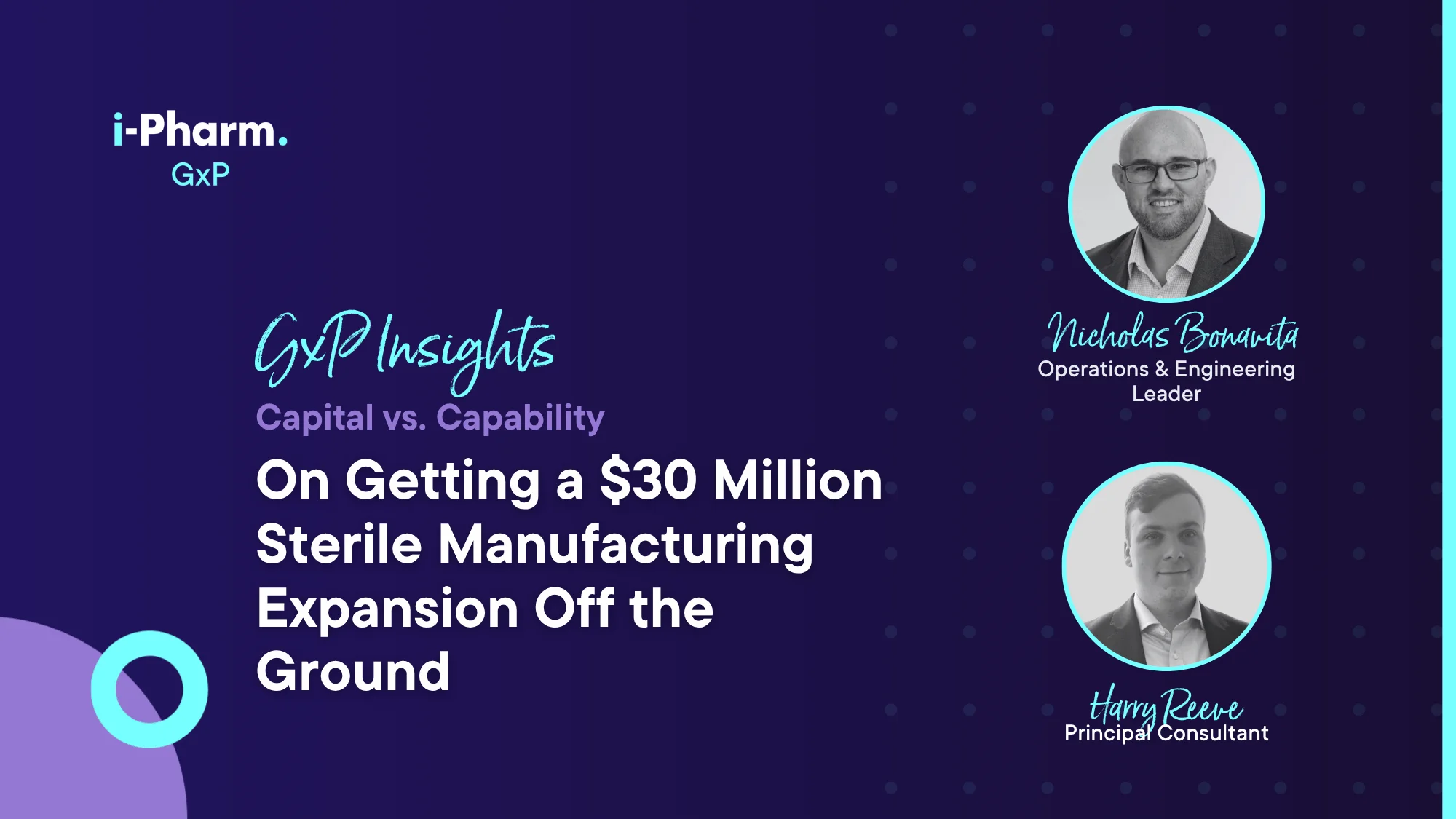
With a career built across some of the most demanding environments in life sciences manufacturing, Operations and Engineering Leader Nicholas Bonavita has led capital programs ranging from tens of millions to well over a billion dollars in scope. In this edition of GxP Insights, i-Pharm GxP's Harry Reeve sits down with him to focus on one of them: a $30 million capital expansion at a specialist CDMO, and what it takes to step into a program of that scale and get it moving.
In keeping with i-Pharm GxP's commitment to client confidentiality, the companies and sites featured in GxP Insights are not named.
When Nick Bonavita came into this program, one of the first things he had to do was get a clear picture of where things stood. Firstly, what the business ultimately wanted. Secondly, what had already been contracted. And thirdly, what was actually required to bring the new capability online. Three things that didn't yet tell a single coherent story.
"The most interesting challenge was translating the business's ambition into an accurate technical plan.”
His job wasn't simply to point out the gaps. It was to turn them into decisions and actions that would bring value to the business.
“Do we adjust scope? Do we add investment? Do we change the resourcing? And bringing those decisions very clearly to the stakeholders, to the core team, and to ownership, so that we can make informed decisions instead of discovering those later."
What makes Nick the right person for a program like this starts well before this engagement. So, let’s take a look at his background first.
The Career Behind the Role
Nick Bonavita is an Operations and Engineering Leader specializing in manufacturing, tech transfer, and GMP, with a track record of building new capabilities and scaling existing pharmaceutical production. His career has taken him across some of the most complex regulated environments in the life sciences industry.
He’s led operations for a $2 billion sterile injectables facility at a global pharmaceutical manufacturer through its initial start-up. More recently, he stood up operations for a viral vector and cell and gene therapy site as it moved toward commercial launch. In between, he directed global technology transfer programs into and across sites in the U.S., Australia, Europe, and Asia, and before that, he led capital projects ranging from the tens of millions to well over a billion dollars in scope.
"That progression has shaped how I look at capital programs. It's not just about the equipment or the facility milestone. It's really answering the question: if operations can run the process, can quality release it? And ultimately, will it deliver the capability the business was purchasing?"